Monday, April 9, 2012

A note to myself

A note to myself today as I celebrate the resurrection of the Lord Jesus in the year 2012:

It is not an easy thing to believe in the resurrection. It seems perhaps easiest to believe in it when I am hearing the words and music of long-celebrated Easter prayers and rituals from my religious tradition. These draw up a deep emotional response that fills me with joy. This, however, does not constitute believing - for a well loved story or childhood song might do the same.

It also seems easy to believe in the resurrection when it is a beautiful spring day and the once gray sky is now a sea of blue, with brilliant sunlight flooding fresh leaves and blossoms. It is not so hard to believe that life can come from death when I see nature's cycle portraying this before my eyes. However, this too does not constitute believing in the resurrection.

To believe that Jesus rose from the dead is especially challenging to the scientific mind of our day. We have learned to believe only what can be "proven". We have been taught not to trust claims that cannot be substantiated. It is hard to believe in the resurrection because I have never personally known anyone who has "risen from the dead". No one I know has either.

And yet I believe.

I make this note to myself today though because I suspect that there will be days in my future when it will be even harder to believe than it is now. I have been fortunate that the pains and losses of my life thus far have been buffered by caring friends or circumstances that eased the blow. I have not yet experienced a loss that turned me inside out, a loss that sucked the air from my lungs and left me gasping. It is when I experience this that I will most need this note.

I believe and yet, it seems nearly impossible to express in words why it is I believe. I remember going through my young adult days when my religious faith had to pass a gauntlet of questions poured forth by my reasoning mind. I wouldn't accept believing in God only because I wanted it to be so. I had to work it out logically that there very well could be a God - or even more, that there must be a God. However, passing that test was only the beginning of my journey toward a resurrection faith.

And perhaps that is one of the most important "whys" of my believing - the journey. Believing has most certainly not been a single moment experience for me nor has it been a smooth straight line. Yet, as I reflect back over my life, I see so much evidence of resurrection. I recall so many times when light has emerged from darkness, hopelessness or fear. What is so especially important about these experiences though is that they didn't start with me. They did not occur because I was smart or because I worked hard or because I was a good person. They came as sheer gift. Completely undeserved - like someone (Someone?) loving me for no reason.

But this was only phase one of the journey. I then discovered that things were being expressed through me that surprised even me. I did not know what to say to a patient and something wise came out of my mouth. Or I found that a poem, painting or photograph "fell into place" to express something that startled me with its beauty. If I were the creator, how could it surprise me? What was expressed seemed to be given for others, much as it was for me, like Someone loving with a love that could not be deserved or earned.

All of this has taught me that there is something (Someone) far greater than anything I can see or prove. This awareness stirs forth from my heart, not from the logic of my mind. Yet it is, I believe, every bit as real of a knowing – perhaps more real. Hence, when I see what appears to be the end, I do not and shall not accept that as full reality but rather as an appearance. It may indeed be the end of one thing. But it may also be the beginning of something else - something much fuller, much richer than what it is that ended.

My belief in this resurrection, however, does not mean that I will always see this as true at the most painful moments. In fact, I probably won't. Much like the disciples of Jesus, I may doubt or reject the idea of resurrection. In my confusion of suffering, the possibility may not even occur to me. When this happens, I may scream and pound on things and feel like my life is over. But I don't want it to end there. Thus, this note to myself. A reminder of what I believe.

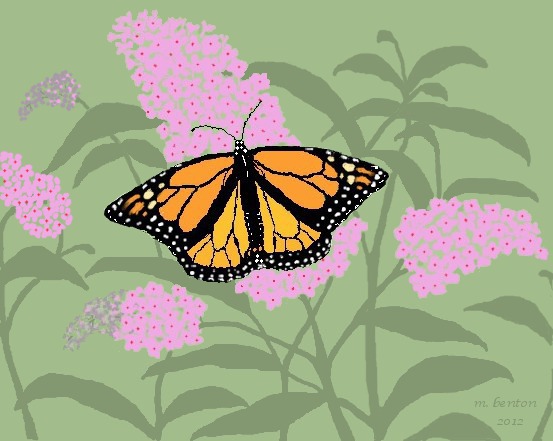
Having said all of this, I realize that I may still be lost when the time of great suffering strikes. And so, an image. A butterfly. A monarch butterfly. The one that can fly 2,500 miles to find the same roosting place its ancestors found the year before. It is not a strong or sturdy creature. It has no map. It has no language or intelligence. It simply has God.

And so have I.


(To my dear readers: below is my Easter gift to you. But before I could give it to you, it first was given to me, one of those experiences that fell into place, so to speak. Many blessings to you today, wherever you may be on your journey.)

Thursday, April 5, 2012

Holy Week: words, images and sounds for the journey toward Easter

I apologize to anyone who has noticed that I haven't posted for almost a month. My life has been unusually busy - not over anything bad - just biting off more than I could chew with an online class and an online Lenten retreat at the same time. While both have been good, the retreat has been so good, so beautiful, so powerful - though not always easy. With other pilgrims on the Lenten journey, there has been much sharing of thoughts, struggles and art. I'd like to share a just a bit of what it has brought me to in these final days of Holy Week.

I have mentioned before my affiliation with www.abbeyofthearts.com through which this retreat was available. Our "abbess" (leader), Christine, has shared many wonderful ideas and images throughout. With her permission, I would like to share some of her thoughts. First, she talked about how we cannot rush to resurrection. Whether we are believers, skeptics or unbelievers, the tendency in all of us is to want to skip the hard, painful parts of life to get to the "Easter" experiences. The final path of Jesus was one of betrayal, rejection, physical pain and abandonment. To consider walking with Him, means walking through these experiences - and most assuredly, we do not want to. Let's just get to the colored eggs, the candy, the family dinner and not have to deal with the gut-wrenching loss of being put to death (whatever that means to each of us as individuals).

Yet we all know, believer or not, that we cannot escape these experiences. Our lives are, at best, dotted with them -  sometimes are filled with them. And one of our greatest challenges as human beings is to accept this part of our existence. These experiences can fill us with confusion, sometimes rage or despair. Where was this so-called loving God when I went through this? Where is He now when I most need Him?

I will show you in a moment where He was, where He is. First, I'd like to share some profound words offered by Christine in the retreat this week:

“We must know the terrible experience of loss wrought again and again in our world so that when the promise of new life dawns we can let it enter into us fully in the space carved by loss.”   
                                - Christine Valters Paintner, OblSB, PhD, REACE

"in the space carved by loss" - these words struck me with great power when I first read them and they still do. I would never say that God sends us loss or pain or any of the other horrible things that afflict us just to accomplish some other purpose. That is not the God I believe in. However, the notion that loss creates a space in us which we can allow new life to fill is very consistent with the God I believe in. He can transform our pain if we give it to Him. Not only that though. He holds our pain and bears it with us. He becomes our pain and, in becoming it, He shares it more intimately than we could believe possible.


I said I would show you where He is/was when you were (or are) suffering. It may seem when I show you, that I am trying to preach the Christian message, to convert you to my religion. Please believe me that that is not my intent - for I respect wherever you may be with believing or not believing. (And if you don't want to continue to the end of this posting, that too is fine.) What I am sharing with you is an artistic expression of images that came from a sacred place within me during this retreat, along with harp strings playing the melody of an old spiritual: Were you there when they crucified my Lord? (I am not claiming good art or musicianship - simply a message coming from my heart.)

(To listen, click on the play button, then continue to scroll down for the images.)


(It does not end here. I hope to be posting again in a few days...)


Wednesday, March 7, 2012

Finding the compassion within...

As I write this, I am sitting in the waiting room of the Cleveland Clinic Neurological Center for Pain. (I am here for a consultation regarding my migraines.) It is a sobering thought to realize that the others sitting here with me are suffering from some affliction, some pain.

Perhaps more sobering though was a sight seen by random chance during the drive here. I was stopped at a traffic light when I saw an older man with a cane in each hand step off the curb ahead. He was wearing a dark trench coat against the wind and snow and had a stubble of a beard. Using the canes to steady himself, he patiently inched his way across the street in front of the waiting traffic. I could not imagine that he would reach the other side before the light changed – but he did. I sense that this slow, laborious movement was a fact of his life. He was not a patient waiting hopefully to see a specialist at a world class medical facility. He was just an old man making his way across the street.
It is not hard to feel compassion when, like this, we are in full view of the suffering of others. We can relate to their visible pain and struggle and wish for their relief as we might wish for our own. However, some sufferings are harder to relate to. Many kinds of pain are hidden from view. Behind the indifference, rudeness or anger of another may hide a hurting heart. Yet when we see someone being unkind, dismissive or worse, compassion for the perpetrator is not likely to arise easily, if at all.

Oddly, even more challenging for many of us is to find compassion for our own hurting selves. So many times I have heard people blame themselves, sometimes viciously, for things over which they have no control. I encounter many people who experience motor or cognitive impairments or physical pain brought on by random accidents or diseases. So many of them are angry – so often, with themselves – because they are the way they are. They feel they should be stronger and more able to overcome the suffering that holds them captive.

When it comes to mental and emotional pain, we seem to be even less tolerant of our suffering selves. It is not uncommon for me to encounter people who hate themselves because of things done to them when they were small children. They blame themselves for not having stopped it, as though a 4 year old could stop molestation or a 5 year old could be “good” enough to prevent a beating. Our adult minds can view another’s childhood suffering with compassion, but somehow our views of ourselves are much harsher, as though our child bodies had adult minds that should have known better.

And then there’s the big one. This is where our capacity for compassion almost always fails us: when we have done something we believe or know to be wrong. “How could I possibly have compassion for myself when I’ve done that?” we think.

Let me share a story. Recently I was corresponding with an online friend, also a therapist, and we were sharing some experiences from our pasts. As a result of this, I was drawn to reflect on an incident from my young adult days that had triggered much guilt and anxiety at the time. While this event had long since been worked through, re-opening it caused an old familiar twinge of discomfort. What happened next though was something entirely new: in this process of reflecting, I had been digging through a box of memorabilia and come across a photo. A photo of me when I was about the age I was when I did “the awful thing”. I looked at the photo and thought: “My God. How young I was.” I could see my youthfulness in my fresh skin and hair. But I could also see it in my soul. I was so young and knew so little about living. I found within me a deep compassion for this young woman, barely out of her teens… and a new level of healing started to unfold. I had always expected myself to do the right thing and to know what the right thing was. “How absurd”, I now realized, “how absurd to have expected that of myself.”

You too have a younger self. Many younger selves. Selves who did not know as much as you do now when they struggled to survive and meet your needs.  And if your younger self was hurt or damaged by abuse or neglect, that self may have remained “young”, i.e. it may not have developed properly with regard to judgments or choices, causing more pain and sorrow. May there not be compassion for these selves too?

With compassion comes Mercy, the great healer of all souls.

I invite you now, if you care to, to join me in a short meditation practice called a "metta" (or lovingkindness) meditation. While the concept is borrowed from Buddhism, it is religiously neutral, ie.g. not likely to be offensive to any formal religion or to those without a religion.
[While this meditation is often done with the eyes closed and the words said to oneself, I have set it up here with some photos taken on a recent walk and with my voice saying some words. I set it up this way for a couple of reasons. First, it helps to demonstrate the idea. Secondly, some people who have suffered trauma, may find themselves flooded with unpleasant thoughts or images when they close their eyes. Thus, if you find yourself in that position, you can use the photos and my voice to help you stay grounded. (If you are one of my patients, please keep me informed of any problems.) You may also change the words to make them more relevant for yourself - I chose the words I did as part of my own meditation. However, you may wish for other things - e.g. to be well, to be calm, to be free of suffering, etc. It is generally good for us to go through the 3 cycles as demonstrated as that can help us cultivate compassion more generally.]

Tuesday, February 14, 2012

love poem

sun and snow and tree
shadow on glistening white
heaven kissing earth


(this Haiku poem was prepared for the poetry party at www.abbeyofthearts.com)

Tuesday, January 24, 2012

Screaming at God

I was a freshman in college. Like all freshmen, I took the battery of interest and personality tests that they gave us and signed up for a time to review the results with the college counselor, Linda L. I do not remember a lot about the results but I do remember one thing: I was in the 99th percentile on independence. I remember Linda giving me a quizzical look, gingerly raising the question of whether there might be problems at home that I was so eager for independence. I denied it, with complete honesty. My conscious mind told me that I had a fine family and we all loved each other. I was just ready to move into the next stage of my life.

In my undergraduate college experience, I was studying social work and criminal justice which required a significant number of psychology classes. I remember reading Freud and all of his ideas about the "unconscious" and the repressed emotions that he taught were the underpinnings of neurosis. I remember not believing it. I believed much of what I studied but an unconscious? No way. Shortly after I graduated from college though I had an experience that triggered something that years later made me revise my thinking.

The details of the experience are not important (sorry to leave you hanging). But what was important was that I started having anxiety. And interestingly, the word "unconscious" itself started to trigger little ripples of anxiety in me. Eventually I got myself into therapy and it was then (years in) that I discovered it. The anger. The rage. A rage that made me want to pound my fists to the floor and scream, "I hate you!" Much of the time, my screams were silent, fully screamed but without my vocal cords since I had neighbors living downstairs. But the screams unleashed something that, years ago as a college freshman, I had no idea existed.

There was, in my case, no forgotten trauma revealed. And my parents really are fine people. So where had all of this rage come from? Looking back, I think much of it came from a simple misunderstanding made as a young child. With my solid Catholic upbringing, I learned to examine my conscience, to identify my sins, confess them and receive forgiveness. I still remember sitting in the church one Saturday afternoon with a prayer book that was to help me with this process. I was leafing through it and saw reference to "the seven deadly sins". I did not know what a deadly sin was - but I knew it couldn't be good. I wasn't too worried at that point in my life about such things as sloth, gluttony or lust. But one that particularly caught my eye was "anger". This one really worried me at the time because, quite naturally, I felt angry from time to time. If this was a deadly sin, my child-mind reasoned, I had to get rid of it, stop it. A deadly sin would cut me off from God, the worst thing imaginable to my pious little mind.

So my life proceeded, with my ongoing struggle to not feel angry - and definitely to not express it. If I felt anger, I would add that to the list of offenses that I told the priest. It would feel good to be told I was forgiven but it hardly seemed to take any time at all for me to again feel angry. It was years later before anyone told me that anger was not a sin - in fact, that no emotions are sins. They are just emotions. But by that time, I had taken a lot of angers, many of them minor, and stuffed them in my mental closet. Because I seldom expressed them, some that could have been cleared up with a bit of discussion, instead festered in there without my knowledge. When the "I hate you" burst forth in my silent screams as an adult, I could no longer deny an unconscious. My anger had been so carefully hidden that, for years, I hadn't even known that it existed.

This is, of course, just a bit of my story, different I'm sure from yours. However, I learned (and am still learning) profound things from it. Besides learning that I have an unconscious, that I can be angry and that stuffing anger inside can make me anxious, I have also learned that sometimes we need to scream. Sometimes we need to spew forth the most ugly and painful feelings in order to be free of them.

While probably few people grow up with my terror of the deadly sin, I think many grow up believing that it is not safe to express anger or rage. Sometimes it may feel unsafe because of an overtly abusive parent who will surely give a beating for something like that. Sometimes it may not feel safe because a parent might withdraw their love, refusing to speak for days or weeks on end. Sometimes it may feel unacceptable simply because there is a culture that teaches that one must not be angry with or even question one's mother or father - or one's God.

Many courageous souls come to me, sharing their pain. One of the saddest things I hear (and I hear it often) is when someone tells me that they hate themselves. Sometimes people even say they loathe themselves. Often people who feel this (and maybe you're one of them) feel that they cannot be forgiven by God and/or they cannot forgive themselves. If I ask them if someone they love did or experienced the same thing they did, without fail they tell me they would forgive that person. But with themselves, it is different. One of the things that is so particularly sad about this is that the people who tell me this are not terrible people; most often they are the "walking wounded", those who experienced or witnessed the unthinkable when they were but innocent children.

Other courageous souls come to me too, sharing other pains. Tragedies - deaths, suicides, murders of loved ones. Unrelenting pain from illness or injury. Diseases that rob the mind or body of the simple joy of being productive. And many, many more sorrows. The question so often is: why? What did I do to deserve this?

As I reflect upon all of this, with the backdrop of my own story, I realize anew that our relationship with God, if we are to have one, cannot always be what many of us were taught. We cannot always approach God with praise. We cannot always tell Him we love him. We cannot always come to Him thanking Him for His goodness and mercy. At least not at first.

Sometimes we need to scream at Him.

Sometimes we need to scream, "WHY?"

Or we need to scream, "Where were you when...?"

Or, "Why didn't you stop that?"

For a relationship with God to be honest, we cannot hide these feelings from Him. When we try, we find ourselves anxious, depressed - even hating ourselves. And even more, we don't allow Him to get close to us. Close enough for us to feel Him holding us in our pain. Close enough to hear Him whispering to us that we are loved, no matter how angry, hurt, sinful or lost we are. Close enough to know He meant it when He said He would rather die Himself than leave us in our suffering...

Come, walk with me down the path to healing - to redemption. It may seem like a lonely, scary, treacherous path. What kind of God could accept someone like me who has so much rage within? Surely no one else has come at God screaming. But then I hear the voices, the laments through the centuries - and I know that I am not alone - that we are not alone...

"My God, my God, why have you forsaken me?" (Psalm 22:2) (Matthew 27:46) (Mark 15:34)

(While researching for this post, I came across a small fact: of the 150 Psalms in the Bible, over 50 of them are considered "Laments", prayers for coming out of pain. Indeed, we are not alone. If you are not ready for a full-throated scream at God, consider reading one of these Psalms. Read it slowly out loud so that you can hear your voice saying the words...)

Sunday, January 1, 2012

Always we begin again...

I had been contemplating what I might write today as the New Year begins and only the vaguest of notions came to mind. I hoped and prayed that the Grace might come, as I know that without it all of my efforts are in vain. My mind felt a bit muddled and my head began to ache, likely from staring too long at my computer screen. So I decided to take a little walk, to clear my mind, though the weather was hardly inviting. "Perhaps I will find some beauty", I thought to myself doubtfully. I stuck my camera in my pocket, just in case.

I put on my winter coat and gloves since the temperature had been dropping. I stepped out and felt the icy pricks of rain upon my face. The sky was full of threatening clouds and the sun so well hidden that the whole world seemed gray. The wind gusted about me. Out of habit, I walked toward the overpass where a number of freeways pass each other in layers. Fire engines wailed, one after another, as I began my quest. The sidewalk too was gray in my monochromatic world, except where bits of litter and decaying leaves added splotches of white and brown. Perhaps today there is no beauty, I thought. It could happen.

As we begin a new year, we encounter an opportunity to look at our lives from a slightly different perspective. New Year's Day is, of course, just another day and we would know no difference without our calendars announcing the change. Sometimes the changing year causes us to look back, perhaps thankful for blessings that came our way in the last 12 months. However, there are those among us for whom looking back is only a reminder that 2011 was the worst year of their lives. Yet either way, there is something about a new year that both frightens and gives hope.

If all I see from my soul's window is sunless gray in endless expanse, I may indeed feel afraid. Can I make it through another year? Do I even want to try, if I can see nothing but more of the same up ahead?

Yet for some sufferers, the hanging of a new calendar brings a sense of relief, a sense of closure to last year's difficulties, offering the possibility that this year will be different. I don't see beauty now because it is winter. But spring and summer will come again... yet so will winter...

Today while walking I allowed myself to see and experience (admittedly for a short time since my skin began to itch and burn from the cold).

I didn't see any blue skies or sun breaking through clouds.

No blossoms or beautiful foliage.

No insects, no wildlife, not even a squirrel.

But I will show you one glimpse of beauty I found in our nearly dormant world.

A dead weed, growing behind a fence, bobbing back and forth in the wind.


And how is this beautiful?

It is beautiful because it is carrying its seed.

It is holding onto its promise of a tomorrow, a life cycle that continues even in the face of outward death.

It carries a new life that we cannot yet see. For from where we are now, we can only see the "deadness" of the plant, the grayness of the world. We can only feel that howling wind and stinging winter rain. But life is hiding inside those seeds - and it is beautiful.

Not long ago, I heard some interesting hypotheses from neuroscience about why negative thoughts are so prevalent in us humans. Why do we seem to remember and focus on the dreadful rather than the beautiful? It seems that we do this to protect ourselves. As a species, we would never survive if we forgot the dangers in our environment - but we could get by if we forgot the beauties. And the more dangers we have experienced, the more watchful and focused our psyches become to negative possibility. So focused, in fact, that we can walk through the world and not see or even remember the very thing we most need to nourish our souls. Little benefit if our species survives but our souls are starved for hope and meaning.

The gift of a "new year" is that it reminds us that we can always begin again. Of course, we do not need to wait until January to allow change into our lives. My life (and yours) is an ongoing journey through many seasons and terrains. There are times of beauty and times of barrenness. There are moments of breaking daylight and moments of chilling darkness. But in each of these, if we are open, if we remember, there is an invitation to be transformed by the Holy.

We will, of course, forget. We will forget the invitation and the promise that lies within it. Yet, as St. Benedict wrote, "Always we begin again." Each day - each moment - each breath - a new opporunity to open ourselves to the Gift.

Join me in remembering the beauty, in this short video offered as my gift to you for the New Year: